
Federal Reserve
Federal Reserve
-

More than 450 economists signed an open letter backing Cook, saying there is a high bar for removing Fed governors and that elected officials should refrain from actions that erode the central bank's independence.
September 2 -
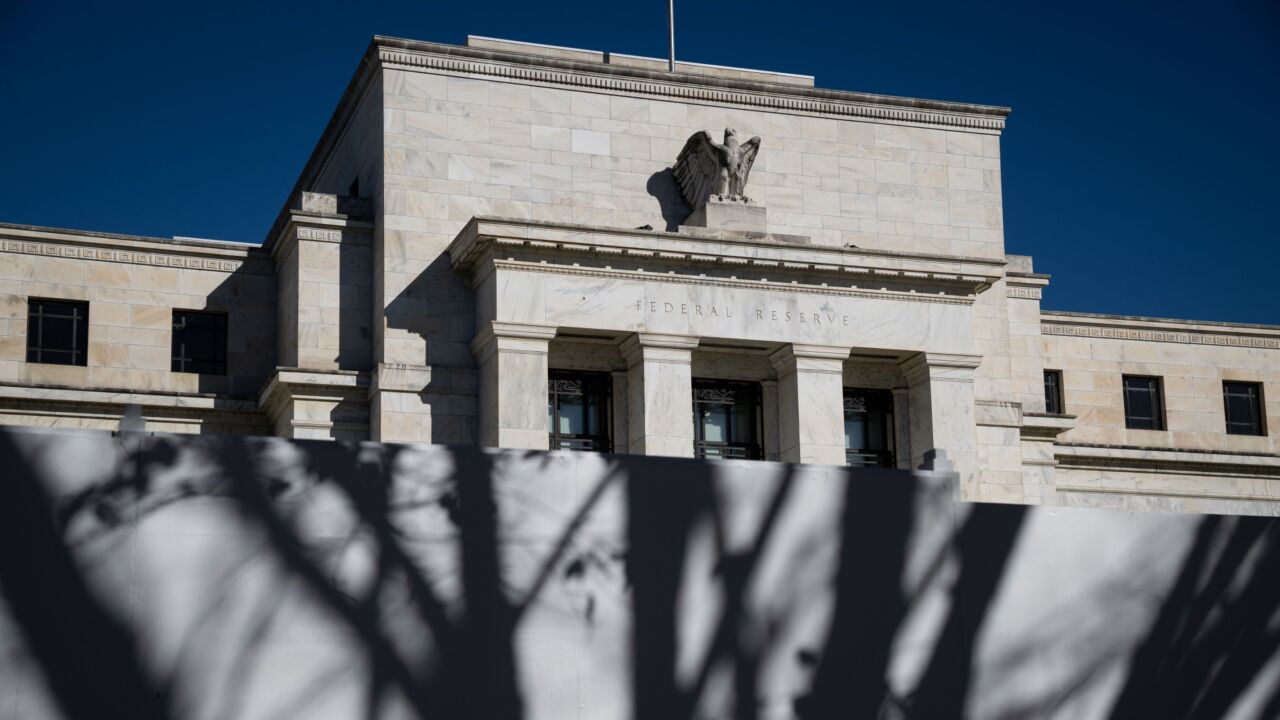
Most big banks saw modest reductions in their requirements following this year's stress tests. The results come as the Fed prepares to smooth year-to-year swings with a new averaging rule.
August 29 -

The D.C. District Court held a hearing this morning and defendants filed briefs in a case to determine whether Federal Reserve Gov. Lisa Cook will remain on the Federal Reserve Board after her ostensible firing by President Trump earlier this week. No ruling was issued, but one is expected before the FOMC votes in mid-September.
August 29 -

In a letter Friday, U.S. Sens. Elizabeth Warren, D-Mass., Chuck Schumer, D-N.Y., and Cory Booker, D-N.J., called on Pulte to address housing unaffordability instead of concentrating on efforts to destabilize the Federal Reserve.
August 29 -

Federal Reserve Gov. Lisa Cook's lawsuit against President Trump is challenging his move to remove her from office because allegations against her do not constitute "cause." How courts weigh in could dictate the future of the central bank's independence from the White House.
August 28 -

The 30-year fixed rate mortgage fell 2 basis points this week, Freddie Mac said, but other sources like Zillow and Lender Price reported larger drops.
August 28 -

Federal Reserve Gov. Lisa Cook filed a lawsuit in federal court Thursday morning seeking an injunction against President Trump's "illegal attempt" to remove her from the Fed board. The suit claims Trump has not demonstrated "cause" for her removal under the Fed statute.
August 28 -

Legal experts say President Trump's unprecedented move to fire Cook over alleged past misconduct will likely be hashed out in court, but there is little precedent to determine whether a sitting board governor can be removed for past actions.
August 26 -

Successfully taking out Cook would give Trump the chance of gaining a majority of his picks on the seven-member Board of Governors. The board is scheduled in February 2026 to vote.
August 26 -

President Trump posted a letter on social media addressed to Federal Reserve Gov. Lisa Cook, informing her that he was terminating her due to allegations of mortgage fraud. The move is likely to tee up an unprecedented legal fight over the Fed's independence.
August 25 -

Researchers at the Philadelphia Fed, in a 2023 report, examined the prevalence of "fraudulent investors" in the mortgage market. Their data set covered 584,499 loans issued between 2005 and 2017, of which 22,431 were deemed fraudulent.
August 20 -

The Federal Open Market Committee member is the third Democrat the Trump administration has accused of committing occupancy fraud.
August 20 -

Fed Vice Chair for Supervision Michelle Bowman warned that focusing too much on technology risks could make banks lose relevance with customers.
August 19 -

KC Mathews, executive vice president and chief market strategist at Commerce Trust breaks down the FOMC meeting.
-

Bond traders' big bet that the Federal Reserve is poised to lower interest rates faces a key moment this week as Chair Jerome Powell gets a chance to weigh in on the economy.
August 18 -

A possible shift in the composition of the Federal Reserve's portfolio of Treasury holdings could result in the central bank buying nearly $2 trillion of bills over the next two years, enough to absorb nearly all of the Treasury's issuance during that period, according to Bank of America Corp.
August 15 -
Funds parked at a major Federal Reserve facility dropped to the lowest level in more than four years, putting in focus the amount of cash banks have sitting at the US central bank, a measure of liquidity conditions.
August 14 -

Approximately 60% of economists surveyed by Wolters Kluwer believe the Federal Open Market Committee will act at its next meeting with a 25 basis point cut.
August 13 -
-

The president said he would soon announce a replacement for departing Fed Gov. Adriana Kugler, adding that it's a "possibility" that his selection for that seat on the Federal Reserve Board will be tapped as the next Fed Chair.
August 5


