
-
The stunning defeat of the Consumer Financial Protection Bureau's arbitration rule didn't have to happen, according to critics and former agency officials.
October 26
-
The Senate's repeal of the Consumer Financial Protection Bureau rule is arguably the industry's biggest policy victory since passage of Dodd-Frank. But is it the sign of a trend?
October 25
-
Republicans were able to use an obscure legislative process to overturn a rule that banks and credit unions feared would raise their litigation costs.
October 24
-
Consumer Financial Protection Bureau Director Richard Cordray pushed back against a Treasury Department report critical of the bureau's arbitration rule, saying it overlooked how class action lawsuits help consumers.
October 24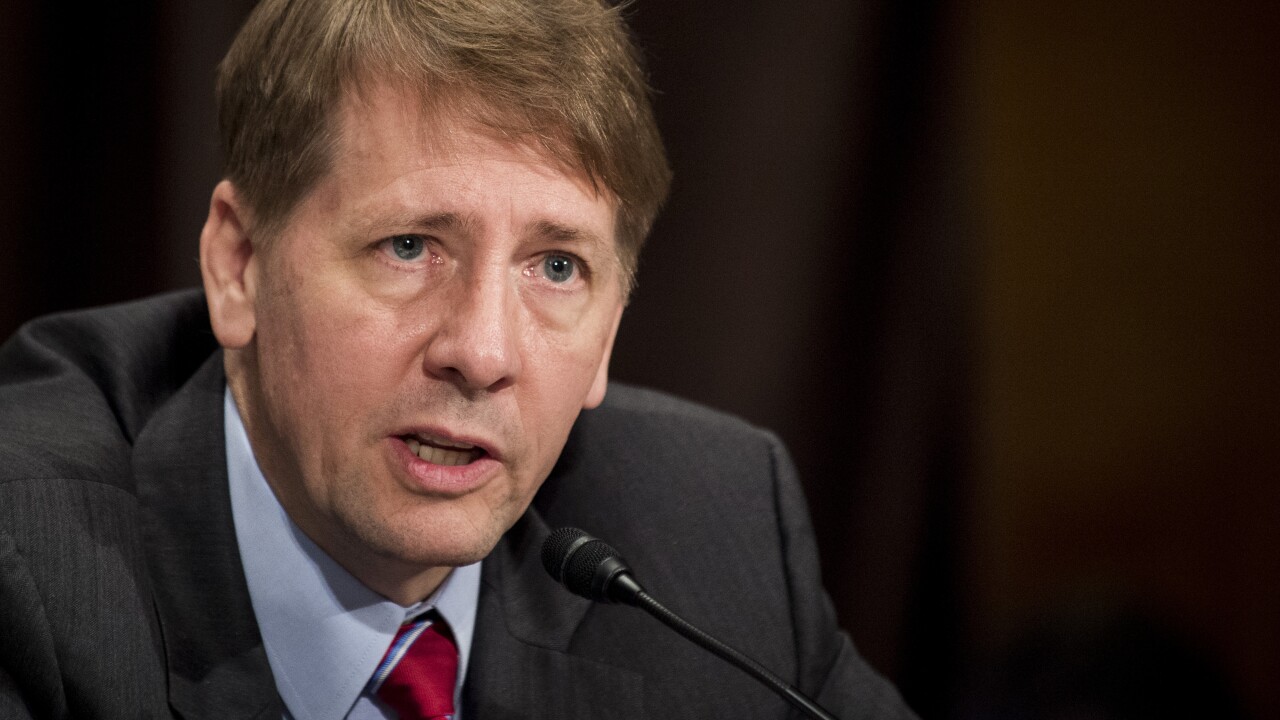
-
The GOP appears to have barely enough votes to roll back the contentious CFPB rule, and floor debate was expected to begin Tuesday with a final vote possible at any time. But victory was not assured, and the fallout could be significant for all sides.
October 24 -
With days ticking down for lawmakers to overturn the Consumer Financial Protection Bureau rule, some are now questioning the statistics used to challenge the bureau’s data.
October 23
-
The Treasury Department released an 18-page report saying the rule would “impose extraordinary costs” including legal fees mostly for lawyers that bring class-action lawsuits.
October 23
-
Regulators usually avoid the public fights that define other realms of the polarized Washington landscape, but the recent tiff over the arbitration rule is an exception.
October 18
-
The Office of the Comptroller of the Currency used "flawed statistics" and misstated the effects of the Consumer Financial Protection Bureau's arbitration rule on community banks, Director Richard Cordray said Friday.
October 13
-
In an op-ed, acting Comptroller of the Currency Keith Noreika argued that allowing consumers to sue financial institutions in class actions would raise credit costs and harm small banks.
October 13
-
The groups argue that the CFPB did not properly conduct a cost-benefit analysis of the rule banning mandatory arbitration agreements and that the final product will harm, not help, consumers.
September 29
-
Democrats have strived to paint recent scandals at Wells Fargo and Equifax as prime examples of why a regulatory rule banning mandatory arbitration agreements should be upheld, but Republicans are not wavering in their campaign to overturn it.
September 21
-
The hearings before the Senate Banking Committee have high stakes for both companies, as lawmakers are expected to ask the CEOs whether they should be fired.
September 21
-
In order to compensate victims of the breach, Equifax is offering free credit monitoring services that include a mandatory arbitration clause, a measure Democrats were highlighting to lobby support for the CFPB's rule banning such clauses.
September 8
-
In a deregulatory environment, a rule that better enables consumers to bring class actions could lead to an explosion of litigation, which will affect product availability and pricing.
September 6 Davis & Gilbert LLP
 -
Payday lenders and arbitration supporters are claiming the CFPB has met more often with consumer groups than industry, laying the groundwork for likely lawsuits on key rules.
August 14
-
Sen. Elizabeth Warren, D-Mass., sent a letter to 16 big banks asking them if they support a GOP effort to overturn the CFPB arbitration rule.
August 10
-
The financial services industry is at risk of being caught flat-footed if a legislative measure to rescind the Consumer Financial Protection Bureau’s rule regulating arbitration agreements fails to pass.
August 4
-
Staff for House Financial Services Committee Chairman Jeb Hensarling said CFPB Director Richard Cordray is continuing to ignore subpoenas tied to the agency's work on the arbitration rule.
August 4
-
Democrats on the House and Senate banking committees are urging Republicans to hold hearings with Wells Fargo's top executives over its phony-accounts and force-placed insurance scandals.
August 1


