
-
The partial US government shutdown is on track to end later Tuesday after the House passed a funding deal President Donald Trump negotiated with Senate Democrats, overcoming opposition from both ends of the political spectrum.
February 3
-
The Senate-approved bill that hadn't yet cleared the House at the time of this writing would fund agencies like HUD through the end of the fiscal year.
 February 2
-
Yields were higher by as much as three basis points, led by tenors more sensitive to changes in Fed policy.
November 13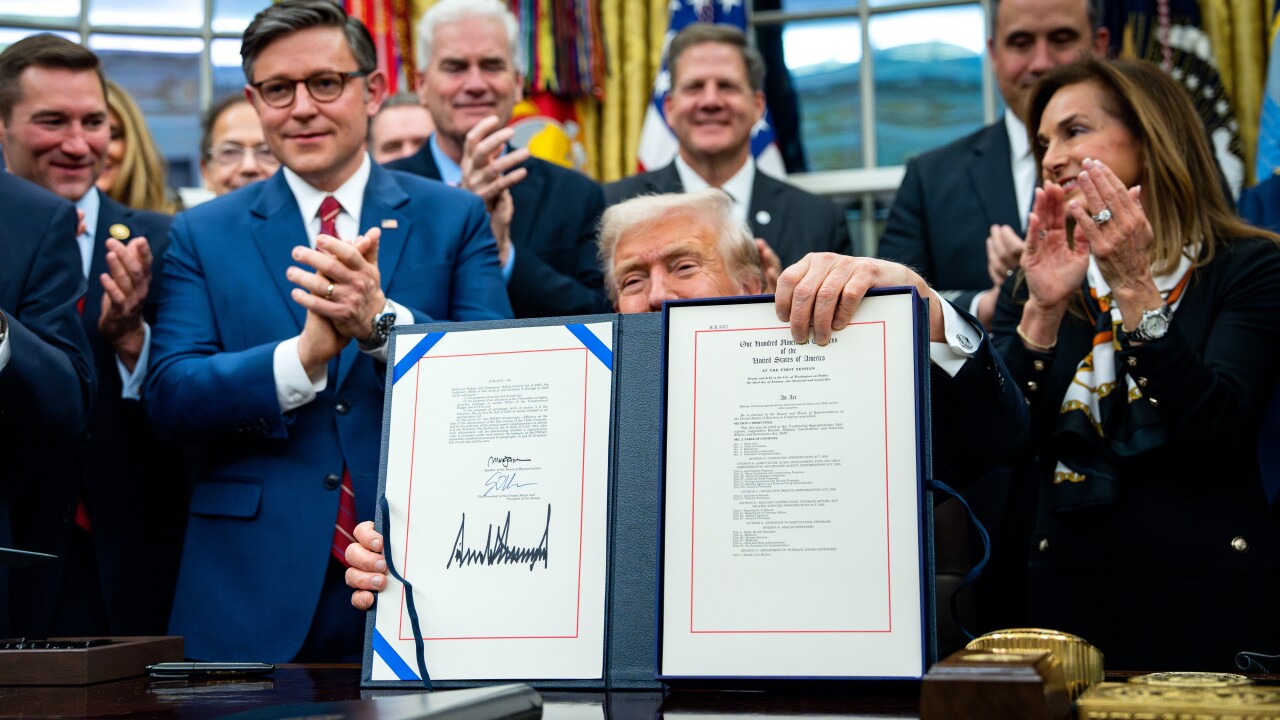
-
Congressmen introduced the Retroactive Renewal and Reauthorization Act to the House Monday, with hopes to backdate the reauthorization of the insurance program.
 November 11
-
The bill would provide pay for furloughed government workers, resume withheld federal payments to states and localities and recall agency employees who were laid off during the shutdown.
November 9
-
Bank of America has a playbook for government shutdowns, which includes providing fee and payment waivers as well as loan deferrals and forbearance programs, CEO Brian Moynihan said at the American Bankers Association's annual convention.
 October 21
-
A judge agreed to expand her temporary restraining order to add more federal worker unions after their lawyers said there's an "urgent" need to prevent layoffs.
October 20
-
Fannie Mae and Freddie Mac's credit risk-transfers and some older private-label mortgage-backed securities have exposures to the Washington DC area.
October 14
-
A lapse in the National Flood Insurance Program because of the US government shutdown threatens to snarl home sales in the nation's riskiest floodplains and leave some homeowners without coverage in the middle of hurricane season.
October 9
-
The shutdown halted the release of employment data, typically a driver of mortgage rate activity, likely resulting in trackers moving in varying directions.
 October 9
-
Some lenders have a workaround for the Federal Housing Administration's suspension of reverse mortgage endorsements but fewer options exist in other instances.
October 9
-
"It's likely going to be in the thousands," White House press secretary Karoline Leavitt told reporters on Thursday, saying that the "entire team at the White House" was working to identify possible cuts.
October 2
-
As the government shutdown stalls key housing programs, lenders are shifting tactics to keep loans moving and preparing for bigger challenges ahead.
 October 2
-
Department officials pushed back on criticism that a banner on its homepage violated a statute meant to curb partisanship in government operations.
 October 1
-
The shutdown started with a flight into treasury bonds, putting downward pressure on financing costs, but several other developments slowed mortgage activity.
October 1
-
The stopgap funding bill paves the way for Republican lawmakers to pivot to signature border and tax bills they seek to pass in the coming months.
March 17
-
The National Flood Insurance Program would ideally be approved yearly, but instead it has gone through 29 reauthorizations since 2017.
March 22
-
The interim measure would finance some U.S. agencies — set to run out of money after Friday — through March 1 and others through March 8.
January 19
-
Frequent federal budget impasses increase insurance concerns and threaten to jack up financing costs that are already straining lenders.
November 14
-
The bipartisan deal struck Saturday temporarily allays concerns that would've required workarounds in parts of the lending process reliant on government agencies.
October 2


