
-
The Trepp CMBS delinquency rate is now 5.18%, a decrease of three basis points from the October level; declines were limited to the industrial, multifamily and office subindexes.
 December 5
-
Testing of the common securitization platform is taking longer than expected, but the Federal Housing Finance Agency said it won't delay the 2019 launch of Fannie Mae and Freddie Mac's new single "uniform mortgage-backed security."
 December 4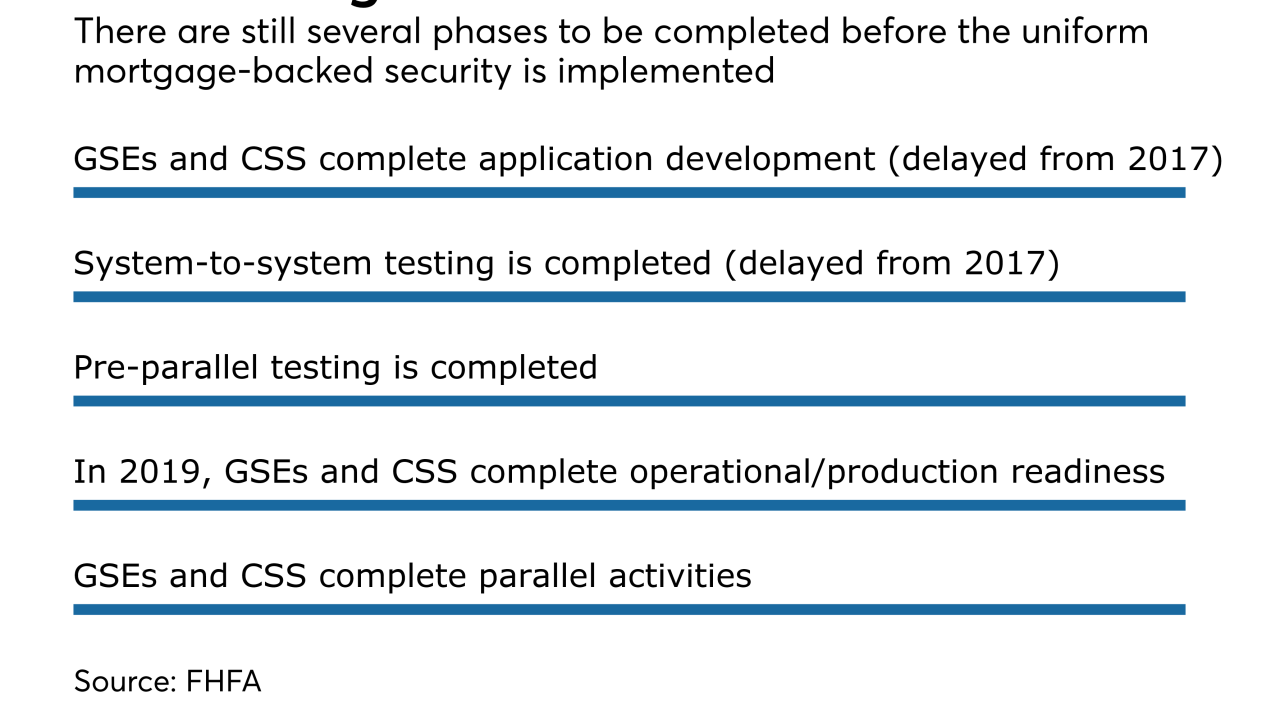
-
New Residential Investment Corp. is planning to purchase Shellpoint Partners in the first half of next year for $190 million with an additional earn-out over the next three years.
 November 29
-
This time it’s the JW Marriott Phoenix Desert Ridge Resort & Spa, a 950-room, full-service resort. A $365 million first mortgage on the property from Morgan Stanley is being securitized via MSC 2017-JWDR.
November 28
-
The Show Me State passed legislation enabling residential and commercial PACE financing in 2010; however, Renovate America only started funding assessments through the Missouri Clean Energy District three months ago, in August 2017.
November 27
-
The senior tranche of Angel Oak 2017-3 benefits from 46.25% credit enhancement, up significantly from 37.75% for the sponsor’s July transaction, but in line with its April deal.
November 21
-
The impending bankruptcy of Walter Investment Management Corp. should not affect its subsidiary Ditech Financial's capability to service securitized mortgages, Fitch Ratings said.
November 20
-
That’s an about-face from the bank’s previous transaction, completed in October, which was backed by fixed-rate mortgages, nearly half of which were underwritten to standards for purchase by Fannie Mae or Freddie Mac.
November 16
-
The private equity firm obtained a $540 million loan on the JW Marriott Grande Lakes and the Ritz-Carlton Grande Lakes, which are situated on 500 acres at the headwaters of the Everglades, from Barclays and Wells Fargo.
November 15
-
The $785 million transaction, 2017-C41, is backed by a pool of 52 loans with an average balance of just $15.1 million, according to Kroll Bond Rating Agency; retail, hotel and office properties dominate the mix.
November 14
-
Impac Mortgage Holdings' nonqualified mortgage origination volume increased 248% year-over-year in the third quarter as the company accumulates loans for a planned securitization next year.
November 9
-
A mortgage on the marquee Caesars Palace Las Vegas is being used as collateral for $1.6 billion of mortgage bonds; proceeds will be used to repay existing indebtedness.
November 8
-
James Bennison, head of alternative capital markets at Arch Capital Group, says that a new insurance-linked security helps with regulatory capital requirements and provides information that can help the company to better manage risk.
November 3
-
A large portion of the collateral for both IH 2014-SFR2 and IH 2014-SFR3 is being rolled into a new securitization, IH 2017-SFR2.
November 1
-
New Residential Investment Corp. may seek to accelerate the process of transferring more than $100 billion in mortgage servicing rights it agreed to buy from Ocwen for $400 million.
October 31
-
The delinquency rate for U.S. commercial real estate loans in CMBS is now 5.21%, a decrease of 19 basis points from the September level, according to Trepp. That is the second-largest rate drop measured in the last 19 months.
October 31
-
Credit Suisse's plan for consumer relief in a multibillion-dollar Department of Justice settlement related to residential mortgage-backed securities could reduce the costs involved, according to the settlement monitor's first report.
October 30
-
Barclays and the Justice Department, engaged in a legal battle over the suspected fraudulent sale of mortgage securities a decade ago, have revived discussions about reaching an out-of-court settlement, according to people with knowledge of the situation.
October 27
-
The deal, known as Bayview Opportunity Master Fund IVb Trust 2017-RT6, pools 2,745 current loans, of which nearly 58% have been clean for at least two years, and 55.2% have been modified.
October 26
-
The second liens, which accompany CMBS first mortgages, range in size from $500,000 to $5 million, a segment of the market that is not well served by either banks or debt funds.
October 24


