
-
Average credit scores for mortgage borrowers remain at a 2018 high, a sign that lenders aren't easing standards despite refinance candidates already falling off on higher rates, according to Ellie Mae.
 November 21
-
Fannie Mae's economic growth forecast for 2018 inched up slightly, but a strong labor market won't mean the same positive results for housing.
November 20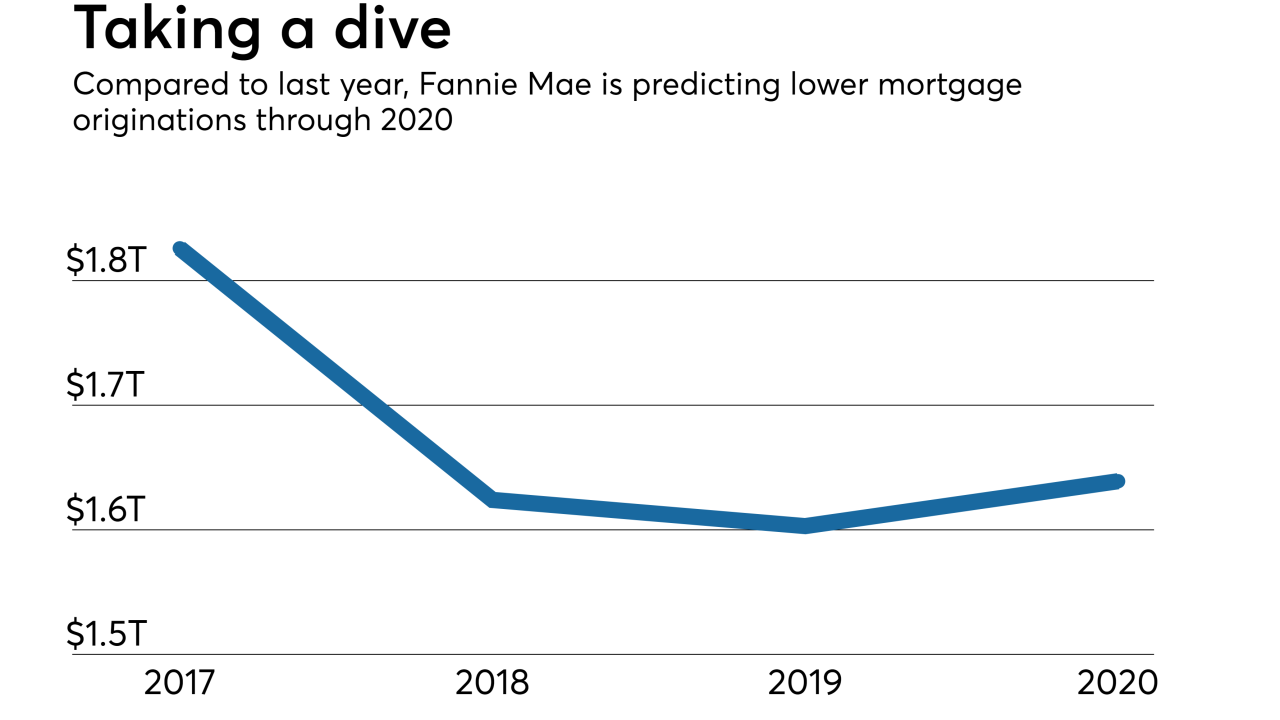
-
The Trump administration should consider putting much of the subsidized mortgage lending done by the federal government under the government-sponsored enterprises to improve efficiency and transparency.
November 19 Walker & Dunlop
 -
The end of one-party rule in Washington could move the needle on efforts to devise a new housing finance framework.
November 18
-
A U.S. regulator's plan to boost capital in the mortgage-finance giants won't work unless investors get "compensated" for the billions of dollars the government has collected from the companies in recent years, one shareholder said.
November 16
-
Fannie Mae completed 10 traditional and front-end credit risk insurance transactions during 2018, sharing $2.6 billion of risk, including $192 million in its final deal of the year.
 November 15
-
The 48,390 homes dubbed at extreme or high risk from the California wildfires burning through the state could cost $18 billion in reconstruction, according to a CoreLogic analysis.
November 14
-
Consumers blame speculative home flippers and wealthy out-of-towners for soaring home prices, but the blame may be misplaced, given many economists' views about the broader factors at play.
November 13
-
The revised blueprint by Moelis & Co. LLC incorporates a pending regulatory capital plan for the mortgage giants.
November 9 -
Continued diversification of its business lines and better margins in its securitization activities helped Redwood Trust overcome steep mortgage origination declines and post nearly 14% annual growth in net income during the third quarter.
 November 8
-
The prospect of growing mortgage rates took a negative hit on consumer perception of home buying and selling during October, according to Fannie Mae.
November 7
-
The Federal Housing Finance Agency is leaving the government-sponsored enterprises' multifamily caps for 2019 unchanged at $35 billion per agency, but is making other changes to prerequisites for excluded loans.
 November 6
-
Returns on mortgage-backed securities in October lagged Treasuries by 37 basis points, the most since November 2016.
November 5
-
The unique approach Fannie Mae and Freddie Mac are each taking with their credit-risk transfer products is quickly becoming a key point of differentiation that's rekindling competition between the government-sponsored enterprises.
November 2
-
Laurel Davis, VP, credit risk transfer at Fannie Mae, explains why the switch to a REMIC structure for CAS is important, and why it took so long.
 November 2
-
Walker & Dunlop acquired commercial mortgage banker iCap Realty Advisors as part of its strategic plan to increase its annual originations by at least one-third in the next two years.
November 2
-
Fannie Mae and Freddie Mac transferred a substantial amount of credit risk to the private sector through both single-family and multifamily market transactions in the first half of the year, with activity expected to rise in 2019, according to the Federal Housing Finance Agency.
November 1
-
The structure reduces counterparty risk in the GSE's benchmark Connecticut Avenue Securities program; it also expands the investor base.
October 30
-
Fannie Mae has priced more securities that support a transition away from the London interbank offered rate.
October 26
-
Despite recriminations about how the crisis and ensuing regulations have tightened loan access, an actual assessment of mortgage credit availability finds the situation is more complicated.
 October 24


